School fee receipt format for India
Where can I get a printable school fee receipt?
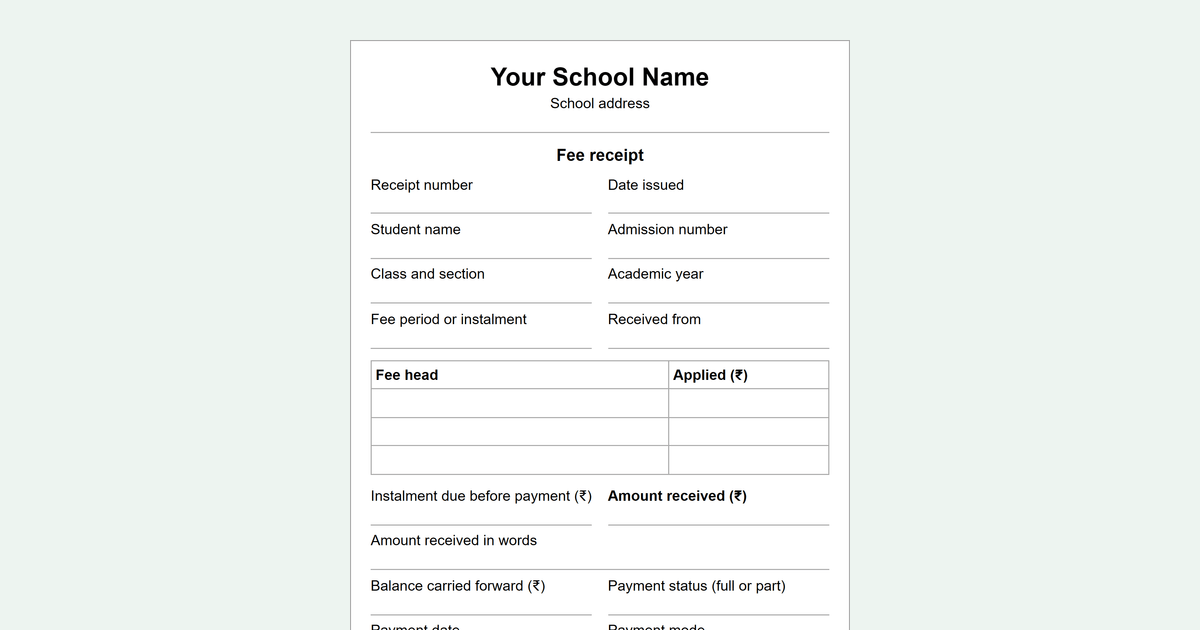
School offices and accountants can use this free template to record fee payments.
Open the printable school fee receipt. Print it or save as PDF from your browser. Choose A5 or A4 in your print settings. Use portrait and turn off browser headers and footers.
What fields should a school fee receipt show?
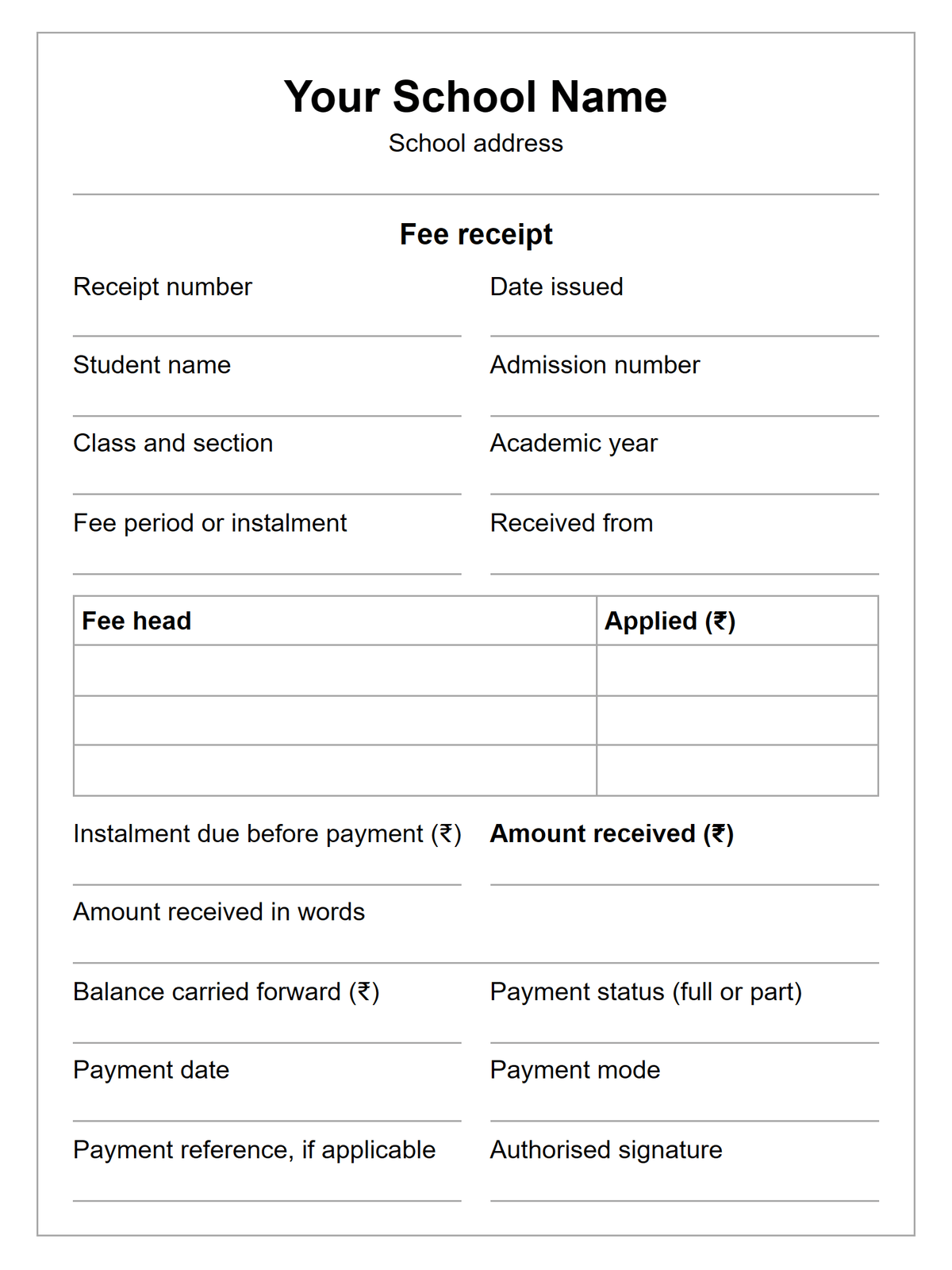
Use your approved fee heads. Check local rules whether you follow CBSE or a state board.
| Field | Why it is there | Required by rule or good practice? |
|---|---|---|
| School name and address | Shows which school received the money. | Good practice. Required for the supplier on a GST bill of supply (Rule 49). |
| Receipt number and date issued | Helps staff find the entry and any copy. | Good practice. GST documents covered by Rules 46 and 49 need an issue date and a consecutive number unique for the financial year. The rules allow more than one series. |
| Student name, admission number, class and section | Matches the payment to the right student. | Good practice. |
| Academic year and fee period or instalment | Shows which dues the payment covers. | Good practice. |
| Payer, payment date and mode | Records who paid, when and how. | Good practice. |
| Payment reference, if applicable | Helps match a UPI or bank credit to the receipt. | Good practice. |
| Fee head and amount applied | Shows where the office put the money. | Good practice. Covered Maharashtra schools must keep separate accounts for different fee types under Rule 12(1)(a). |
| Instalment due, amount received, balance and payment status | Shows how much the school received and what the family still owes. | Good practice. |
| Amount in words and authorised signature | Helps check the written amount and who issued the receipt. | Good practice on this template. |
In Uttar Pradesh, covered schools must issue a receipt for every fee or charge levied on a student. Coverage depends on sections 1(3) and 3(9) of the UP fee law. Maharashtra's rules also list the fee receipt and fee collection register among the records covered schools must keep. Maharashtra fee rules, Rule 12(3).
How do I write a receipt for a UPI part payment?
Fictional example. One student's second instalment has ₹12,000 due. The parent sends ₹7,000 by UPI, and the office confirms the credit in the school's bank record.
| Receipt entry | What to record |
|---|---|
| Student and instalment | Sample Student, Class VII A, instalment 2 |
| Instalment due before payment | ₹12,000 |
| Amount received and applied to tuition | ₹7,000 |
| Payment mode and reference | UPI, reference EXAMPLE-01 |
| Payment status | Part payment |
| Balance carried forward on instalment 2 | ₹12,000 − ₹7,000 = ₹5,000 |
Enter ₹7,000 as received in the fee register. Carry ₹5,000 forward as unpaid on the second instalment. When the next payment comes in, check the register before posting it.
How should the office handle cash, duplicates and cancellations?
Suggested office practice
- Cash. Count it at the counter, issue a receipt and match it to the cash book and fee register.
- Duplicate. Mark the copy “Duplicate”. Keep the original number and date, and record the reprint date. Leave the existing payment entry in place.
- Cancellation. Keep the cancelled receipt number and record the reason. If the office posted the payment in error, have the accountant review and link any reversal.
- Part payment. Record the amount received, where you applied it and what remains due.
Compare the receipt with the fee register before closing the day. See how a receipt can disagree with the register, or read the guide to keeping school fee records.
What is the cash limit?
Subject to its exceptions, section 186 of the Income-tax Act, 2025 bars cash receipts of ₹2 lakh or more. The limit applies to each of these tests. Section 186(1)–(2).
- The total from one payer in a day.
- The total for one transaction, even across days.
- The total from one payer for transactions tied to one event or occasion.
Splitting a single transaction across days still counts towards the same limit. CBSE Circular 12/2026 advises schools to promote digital payments. CBSE's affiliation bye-laws also call for digital transactions. Check your school's rules before accepting cash. CBSE Circular 12/2026 and clause 6.4.
Is GST charged on school fees?
Tuition at a qualifying school is GST-exempt. Entry 66(a) covers services the school provides to its own students, faculty and staff. The definition includes preschool through higher secondary or equivalent. Notification 12/2017, Entry 66(a) and paragraph 2(y)(i).
- Transport and catering. School-run transport for its own students can qualify under 66(a). A contractor supplying covered transport or catering to the school can qualify under 66(b). A vendor billing parents directly for its own transport service falls outside 66(b)(i). Entry 66(a) and (b)(i)–(ii), read with the 2018 amendment, paragraph 1(o).
- Uniforms and books. A shop's separate sale of uniforms or textbooks falls outside the school services exemption. Check the GST treatment of the goods. Entry 66.
- Coaching. Commercial coaching carries 18% GST when no exemption applies. Notification 11/2017, heading 9992 and SAC 999293.
A GST-registered school generally issues a bill of supply for exempt services. Use the fee receipt to acknowledge payment. Ask your accountant which GST document to issue with it. CGST Act, section 31(3)(c) and Rule 49.
Quick answers
Is a revenue stamp needed?
Article 53 lists a ₹1 duty on receipts it covers when the amount exceeds ₹5,000. Ask your CA which state rules and exemptions apply to your paper or digital receipt. Indian Stamp Act, section 2(23) and Schedule I, Article 53.
Can parents use the receipt to claim a tuition deduction?
Keep the receipt as a record of the tuition paid. Under the old tax regime, eligible parents can claim qualifying tuition they paid for full-time education in India. This applies to up to two of the parent's children. The ₹1.5 lakh limit covers all qualifying payments under section 123 together. Income-tax Act, sections 123 and 202 and Schedule XV, paragraph 1(q).
In Manabi, each school has its own receipt numbering series. Parents can see fees and download receipts online. Parents report bank or UPI transfers for the school office to verify.
If you're comparing software, see the school management software guide or book a demo.
Sources
- GST education exemptions, Notification 12/2017 and 2018 amendment
- GST service rates, Notification 11/2017
- CGST Act and CGST Rules
- Income-tax Act, 2025, as amended in 2026
- Uttar Pradesh fee regulation Act and Maharashtra fee regulation rules
- CBSE digital payment circular and CBSE affiliation bye-laws
- Indian Stamp Act
Research checked 26 Nov 2026.
Ready to Modernize Your School?
See ManabiApp running on a school like yours. Book a free 20-minute live demo with our team.